Speech of the Universe
Essays in Martinus cosmology
By Thorkil Schultz Nielsen
Translated by Olov Fahlander
 Reincarnation, karma and development.

Microcosmos, mesocosmos and macrocosmos.

Reincarnation, spiral cycles and destiny.
1. According to Martinus it is important to start by looking at nature in order to understand the cosmic life principles [39]. Nature with all its life organisms should be regarded as a part of the divine cosmos. In one period of the spiral turn, and in order to advance in its development, each single eternal being, has a need to experience life through organisms that we know as plants and animals. This experience is necessary for the being, since it will renew its consciousness through evolution. The daily and yearly turns are to Martinus elements to the understanding of the way in which life evolves and thus life will be renewed over and over again. All energy or forms of motion evolves in spiral movements, and mankind experiences the daily turning as night and day, the yearly turning as summer and winter and above that the earthly life cycle that consists of life in the physical world, followed by life in the spiritual worlds. |
Symbol 14 The Cosmic Spiral Cycle I © Martinus Ideal Fund 1963 See a closer analysis of the symbol under "Microcosmos, mesocosmos og macrocosmos" or in "The Eternal Worls Picture II" by Martinus under symbol 14. |
2. In the same way that the daily cycle and the yearly cycle repeats itself,
the present terrestial human's life on earth is in itself not the only one,
but it is a link in a continuous row of lives, that the being is in the
progress of experiencing [40]. In the same way that nature is made up of
forwarding cycles, the human being is born in its childhood, represented
by the principle of winter, where it receives help from its parents, to
its first step in the earthly state of existence. Its life is now stagnated
from the old age of a previous life or autumn, to its more or less sleeping
state. . |
Childhood. |
3 In the course of youth, represented by the spring principle, the individual is prepared through bodily and mental development, for independence |
Youth. |
4 As a grownup through the need for activity, the person has a possibility to realize its ideas and to develop the entire strength of its soul, its knowledge and manifestation. They have a possibility to acquire a deeper understanding of the meaning of forgiveness and neighbourly love, dependent on their state of development. The grownup person, Martinus compares with the principle of summer, in which nature culminates its evolution, and whose uppermost goal is to be of inspiration and joy for all living beings. |
Manhood |
5 In the autumn of life, in which the organism grows older, the human being sees in the light of remembrance, looks back on what has happened. In the same way that leaves will fall from the trees, we also lose our power to evolve in the physical world, and then progress to the spiritual world through that which humans call death, but which Martinus calls "the 2nd birth" [41]. After a stay here the human being again returns to a new earthly life's mental winter state, which is childhood. |
Old age. |
6 Even if a day and night or one year is ended, it does not mean that all is gone. All living beings will pass through the same phases, and when they are through with one cycle, it will enter a new one. The same applies to man. When one earthly life is ended, it will progress after a pause in the spiritual world, with yet another. The abilities and talents that are accumulated during one life are stored in the consciousness and may thus be used in the next life, if there is a need for it. Man will mature successively to be able to deal with all properties as a genius. This maturing culminates when the real human being appears as a genius in its way of being and neighbourly love. |
Childhood. |
7 Up to the age of about 30 years, one repeats all ones previous incarnations.
This must be understood in such a way, that one repeats those characteristics
that have been dominating in these incarnations. One repeats ones later
incarnations more intensively and spends more time on them, the sooner the
30'th year is approached. 8 In the course of childhood those incarnations are repeated that were much further on back, than those that are repeated in the youth. The repetitions in childhood of earlier incarnations are thus quite short, since they already have been repeated many times before. When the individual matures though youth, morality is trained more and more. In the course of the years between 20 and 30, the three last previous incarnations are repeated. Slowly but surely, the heights of development are reached, that all the previous experiences through all earlier incarnations has brought one up to. This is not only a matter of the finished creation of a physical body, but also of the maturing of the spiritual organs and organic structures that will assure that quite simply they are matched to use ones properties in full. The spiritual capacity is first matured or finished building at the age of 30. Thereafter one advances into new life areas and experiences that will bring one further in the knowledge about good and evil. |
Youth. |
9. Even if a human dies, they will not be extinguished. They live on in that which Martinus calls the state of in-between, in which after the removal by suggestion of negative thoughts, one is allowed to have ones innermost wishes and dreams fulfilled. Thus, there is no ground to fear neither life nor death or the complete emptiness, that many materialists believe in. Life continues in the true spiritual worlds, in relation to what this being has dealt with in the physical world. Martinus will in no way recommend burning corpses, since the still-living micro beings of the human body, will suffer enormously. Then, according to him, it will be better for the living beings, that the human will get a ordinary earth burial, since then they will have a longer time to die a natural death. Martinus thus sees a future, where there is research into different forms of embalming that give the micro beings the possibility to live their life naturally to the end. |
Laying a wreath. |
10. It is only in the physical world, that the actual learning process can take place, and this is also where the development towards the perfect morality takes place. That which, from a human perspective appears as disconnected or illogical acts, will give from a divine point of view possibilities for the individual to mature through experiences. Without these experiences it would not be possible to see the consequences of ones acts. At the more primitive stages in development, a being is convinced that it would be possible to extinguish the enemy. One will however more and more understand as things develop through painful experiences, understand what will promote unhappiness and what will promote happiness both for oneself and for others. The physical world is not only resistive, but gives also at the same time possibilities for life experiences, that to a high degree will teach this being to live through the pleasures that it receives, when acting or thinking according to the law of neighbourly love. Man, thus has a possibility to learn from experiences, whether it creates sorrow or happiness. |
Soldier
|
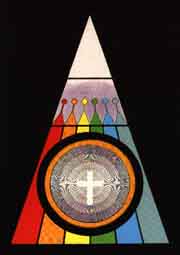
11. Each time, that the human being has acquired a new experience, this will contribute to the build-up of a new ability or a new talent. These talents have their seat in X2, in an organ that Martinus has called "the element of creative ability" [42]. In this element are all abilities or talents that the human being has created through its physical incarnations. When one incarnates again in the physical world, one thus brings with one these abilities or talents. In X2 we see some round coloured areas, these symbolise the basic talent kernels or, "spiral centres" of this being. They are connected to coloured triangles that symbolize an eternal organ structure. With these the I can create its changing and thus also temporal organ structures. All talents that are thoroughly trained, both positive and negative, are automatically kept in the element of creative ability. |
Symbol 6 The Living Being I © Martinus Ideal Fund 1963 See also under "Universe". See a closer analysis of the symbol in "The Eternal Worls Picture I" by Martinus under symbol 6. |
12. "We live in the middle of great manifold of creational processes. And if we look at those processes that are finished, we may see that they all, inescapably and without doubt, will be for joy and blessing to all living beings. There is not one single occasion, which does not result in joy and blessing. So the Divine creation has this intention in its final results to create joy and blessing for the living beings. We may look at our own organism. When we see its hundreds of different functions, performed by various organs that fit into each other, and it all seems so perfect, that we do not notice any of that at all. They act automatically, and bring about that we have a perfect instrument, by which we may experience the physical world, as long as we do not ourselves interfere and ruin this instrument " [43]. |
Martinus at the platform 1956. |
13. It may take several incarnations to build and develop a talent up to geniality. Martinus separates this process into three steps, an A-stage or period of theory, a B- stage or a training period, and finally a C- stage, that corresponds to being a genius within that trained area. For each time, as an example, an artist will incarnate, it becomes easier to perform that form of art, since the artist will build on the already present talent in that field. |
Violinplay. |
14. With the knowledge that Martinus already has, he of course has no wish to harm or hurt anyone. He is however forced to stress that this principle also must be considered when it comes to the build up of negative talents. A person, that already in a previous life has had an excessive demand to consume unnatural amounts of alcohol, is born with that talent, and a demand to continue their drunkness. But within a few lives, this burden can break down a persons talents for a healthy normal organism, and in its outermost consequence the drinker may be born with an disabled body, and may be living for example with a severe mental deficiency. This person will then no longer be able to take care themselves, and must have help from other people, so that they slowly may start to regenerate. It is with this background of talent kernel creation, that Martinus warns against excessive intake of alcohol, and also of course the consumption of other harmful agents such as narcotics. |
Martinus lectures. |
15. The principle of building up neighbourly love is the same as in the building up of other talents as well. This constant training to do good across numerous incarnations will at last have as result that this person will appear as a genius in morality. Then the talent of neighbourly love will be so much developed and so permanent, that this being only is able to display neighbourly love. Only now, is it organically developed to receive and withstand the energy of intuition, that is the basis for "the great birth", or cosmic consciousness. |
Symbol 23 The Finished Human Being in God's Image after his Likeness © Martinus Ideal Fund 1964 See a closer analysis of the symbol under "Reinkarnation, karma and development " or in "The Eternal World Picture II" by Martinus under symbol 23. |