Speech of the Universe
Essays in Martinus Cosmology
By Thorkil Schultz Nielsen
Translated by Olov Fahlander
History and development.
1 The exploration of matter and the application of the results of this research have helped humanity to realize a wish to become masters of the material existence. Essentially the materialistic development has meant that each one has gotten the ability to make logical conclusions at the expense of the previous strong ability to believe. |
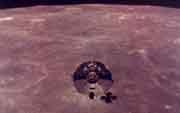
Moon landing 1969. |
2 Martinus, who lived for many years in Frederiksberg, Copenhagen, gives in his cosmology a very detailed explanation for the deep mysteries of existence. In contrast to religions, the intention of this cosmology is to be understood by logical explanations. Thus Martinus explores by logic, the basic elements of Christianity such as forgiveness and neighbourly love. A very essential prerequisite for these new insights is the principle of reincarnation, or the fact that a human being lives one life after the other in the physical world. We should also mention that Martinus was much inspired by the pyramids of Egypt. For him, the sphinx was a symbol for the evolution from animal to human, while the pyramids were used to find a pharaoh to lead and rule the country. This pharaoh was found through initiation rituals that resulted in finding that person who was best suited. This form of leadership was the most ideal for the development at this particular time. Martinus in his new idea of the universe gives a very essential contribution to resolve the relationships between reincarnation, karma, development, forgiveness and neighbourly love. |
The Martinus Institute, Frederiksberg, Copenhagen, Denmark
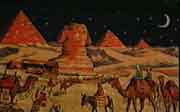
Carpet from Martinus´ apartment or museum, that illustrates the spinx and the pyramids. |
3 "What it's all about is to give life, to create, in order to make happiness, lightness and joy. And we can see among humans today, that they are at different stages, so that some people are still able to do much evil, while others have attained an ability not to be able to do nearly as much evil, and that this development still continues. This development can furthermore be emphasized and be a fact in this terrible suffering, which the bestial tendencies in humans bring about. But it will also create a new ability in humans, which is humanity " [2]. |
Martinus lectures |
4 To illustrate the eternal worldpicture that he describes in his work, Martinus has made a large number of symbols, whose purpose is to give a visual overview of his analysis. In one of these many symbols, i.e. the one he calls the main symbol (symbol 11), Martinus explains the structure or construction of the entire universe. It illustrates how God appears as a threesome principle or as a living being, in which all other living beings live their own lives. The threesome principle of God consists of a creative and experiencing self, which is illustrated through the star in the middle. Furthermore there is a creative ability, illustrated through the violet border. Finally there are the created realities, which are shown through the six coloured areas, which constitute God's consciousness and organism.The small white areas in the violet border of the symbol illustrate all the micro I's of God, including here the I's of human beings. |
Symbol 11 The Eternal World Picture, the Living Being II, The Eternal Godhead and the Eternal Sons of God. © Martinus Ideal Fund 1963 See a closer analyses of the symbol under "Universe" or in "The Eternal World Picture I" by Martinus under symbol 11. |
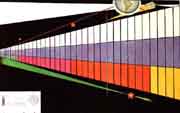
5 These three-parted figures, along beside each other, thus symbolize each one a living being, that with it's eternal past, in its present, experiences life heading forward towards an eternal future. The beings will grow through this development, from mineral forms through plant forms, animal forms, and from there through earthly human forms up to being totally perfect humans in the kingdom of God. These life forms each create the development levels which we commonly know by the concepts: mineral kingdom, plant kingdom, and the animal kingdom, which the present earthly human being is also a part of. Every person qualifies for the totally perfect and complete human kingdom, in accordance to how they develop their moral and neighbourly love. The kingdoms are symbolised respectively by the light indigo, the red, the orange and the yellow colours. The earthly human's area of development goes from the vertical white line in the animal kingdom, and forward to the yellow area, which symbolizes entry to the real human kingdom [3]. |
Symbol 4 The Road towards Light © Martinus Ideal Fund 1963 See a closer analysis of the symbol in"The Eternal World Picture I" by Martinus under symbol 4. |
6 On a longer view the human development is in the direction of creating a perfect material and spiritual kingdom of humanity, which encompasses all human races of the world. The yellow sun in the middle of the symbol, expresses the common government of the entire humanity. The round white areas with the black arrow symbolize the different states and nations of the earth. They are subordinated to the common government or supremacy which the sun in the middle symbolizes, whose beams they are now within. The colour of the beams, which are yellow and green, symbolizes that the states are governed through intellectualized feelings. This colour combination here means realization of neighbourly love [4]. |
Symbol 26 The Perfect Human Kingdom of the Future © Martinus Ideal Fund 1964 See a closer analysis of the symbol under "The development of society" or in "The Eternal World Picture II" by Martinus under symbol 26. |
7 According to Martinus, Christ received a cosmic glimpse, when he was baptized by John the Baptist in the river of Jordan, and later received cosmic consciousness when he was together with Moses and Elijah and experienced the transfiguration on the mount [5]. With these experiences Christ began his teachings or education of humanity, whose purpose was, and still is, to bring it forward to the creation of a perfect human kingdom on earth. For Martinus there is no doubt that Christ spoke about reincarnation [6]. This he did for example in his discussions with Nicodemus described in St. John's gospel, when Christ said that "no one can see the kingdom of God, unless he is born again" [7]. Furthermore, in the gospel of Matthew where Christ spoke about John the Baptist, when he said: "And - if you can accept it - he is Elijah, he who would come" [8]. |
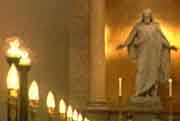
Thorvaldsens Christ figure in "Vor Frue Kirke"(Our Lady's Church) Copenhagen. |
8 The materialistic development or the improvement of the material conditions of living, according to Martinus, would have been delayed, if the thoughts of reincarnation had been incorporated too early into western culture. Thus, in a larger perspective, there is a reason for the fact that to begin with it was left out of the Christian teachings. If the thought of reincarnation had been accepted at once, humankind would not have been so motivated to improve the material conditions of living or existence here and now. The theory of a single life and materialism would in that case not have had the same form and power as it has had. |
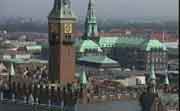
Overview of Copenhagen with the Town Hall and and Christianborg (seat of the Danish Government). |
 Reincarnation, karma and development.

Microkosmos, mesocosmos and makrocosmos.

Reincarnation, spiral cycles og destiny.