Speech of the Universe
Essays in Martinus cosmology
By Thorkil Schultz Nielsen
Translated by Olov Fahlander
Human materialism.
1 The cosmic analyses show, that the development of humankind passes from primitive egoistics to highly intellectual ways of being with all-embracing love. This development occurs through numerous lives, where the experiences gained about good and evil are continually transferred incarnation by incarnation. Reincarnation has as its ultimate purpose to create a perfect knowledge of what is good and what is evil, which is the same as gaining the abilities to express this perfect way of being. |
Symbol 11 The Eternal World Picture II, the Living Being, The Eternal Godhead and the Eternal Sons of God. © Martinus Ideal Fund 1963 See a closer analysis of the symbol under "History and development" and "Universe" or in "The Eternal World Picture I" by Martinus under symbol 11. |
2 Thus, each human being is on their way forward in their development.
At a certain point in time in this long process of creation, this being
reaches a state of consciousness, where it entirely denies the existence
of God. Old, more primitive abilities and character qualities are being
replaced successively with new abilities and skills. The state of consciousness
we are here refering to, is that in which the human being culminates in
material knowledge, i.e. knowledge about the laws of matter, gained by research.
This knowledge is expressed in many different ways. Successively as the
ability for religious belief more and more degenerates, this being finds
it more and more difficult to accept the religious explanations and belief
statements. At this state in its development the human being appears as
a non-religious materialist. 3 In spite of his extensive knowledge, the materialist lacks an overview
what is of service and joy for humanity. History has many examples of how
research in the physical matter and the growth of materialism has been beneficial
for humanity, but at the same time the same research has also contributed
to extensive misfortune for humanity. Humanity gradually discovers, through
the experience of suffering over many lives, that its knowledge about material
matters cannot prevent the evil of the world occuring. On the contrary,
they see that human sufferings grows to tremendous dimensions, in pace with
the growth of science, as long as this growth is not being used in the service
of humanity. Slowly there develops a hunger to find a humane and righteous
meaning with life. The materialist's own experiences of suffering has lead
to a more humane way of being, i.e. reaching a large knowledge about what
is good and what is evil. Interest in moral ideas, becomes more prominent
and there occurs a search for a new humane moral that can assure justice
and righteousness for each and everyone, and which ensures that the results
of materialism will act in the service of humanism. 4 To what degree neighbourly love is developed in each person is, thus, according to Martinus, determined by the amount of suffering he or she has experienced in this and in previous incarnations. The more suffering a person has experienced, the greater understanding and sympathy for other people's unhappy situations in life. They are satiated to the point of disgust with war and other sufferings which humans inflict on each other. The humane materialist thus becomes a spokesman for peace, and as time goes by, many of them engage in humane actions, which have as their purpose to reduce sufferings, for both humans and animals. At this point in time of development, the humane materialist lacks only a superior knowledge of the laws of life and a logical argumentation to show why it is purposeful just to improve life and life happiness of all living beings, everywhere, where it is possible. |
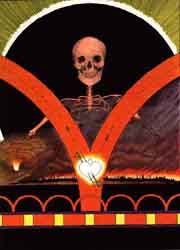
Symbol 19 Through the Initiation of Darkness (Hell or Armageddon) © Martinus Ideal Fund 1964 See a closer analysis of the symbol under "The mission of darkness" or in "The Eternal World Picture II" by Martinus under symbol 19. |
 Reincarnation, karma and development.

Microkosmos, mesocosmos and makrocosmos.

Reincarnation, spiral cycles and destiny.