Speech of the Universe
Essays in Martinus cosmology
By Thorkil Schultz Nielsen
Translated by Olov Fahlander
 Reincarnation, karma and development.

The mission of darkness.
1 Many of today's humane materialists, for whom it is an urgent mystery
to solve and justify the sufferings of the world, are searching, more or
less consciously for an acceptable explanation to the great amount of evil
that there is. They have a long time ago grown past the explanation that
it is the work of the devil that is the cause of all the evil and whose
only concern is that they must end up in hell. Also, they cannot understand
the logic of a God that ought to be all knowing, with all power and in particular
all loving, that allows that there is evil and sufferings in this world.
In that case it must have been a sadistic God. 2 As previously has been shown, Martinus symbolizes the entire universe or the consciousness of God, in what he calls the main symbol. Here there is one section, which is the orange area, also called the animal kingdom, where killing thoughts or manifestations can be expressed. According to Martinus' analysis of the mission of darkness, the manifestation of evil shall not be regarded as a power that exists outside the consciousness of God. The mission of darkness is that the living entity in a particular stage of its development should learn to know the evil. Without this knowledge the living entity cannot in any way learn what good is. And without this, the living entity could never be able to manifest the perfect way of being. Darkness is thus an indispensable part of the plan of God, which is to bring the human being forward to cosmic consciousness, that state where one is in contact with the innermost knowledge of the all embracing love. This contact occurs at the entrance to the real human kingdom, which is marked by the yellow section. |
Symbol 11 The Eternal World Picture, the Living Being II, The Eternal Godhead and the Eternal Sons of God. © Martinus Ideal Fund 1963 See a closer analysis of the symbol under "History and developement " and"Universe" or in "The Eternal World Picture I" by Martinus under symbol 11. |
3 In the animal kingdom the development of darkness or "the killing (slaying) principle" [16] is a natural part of its conscious mental life, wherein the animal to a major part has its vital conditions by killing. When the intelligence energy in the animal kingdom, just begins to emerge, this dawning intelligence becomes in the service of the "killing principle" and will help the animal in its fight for survival. By the help of intelligence which in itself is neutral, humanity has brought forward much good, but since they are still present within the animal kingdom and thus also "the killing principle", this intelligence has been used to manifest power and the subjugation of fellow beings. |
Lions |
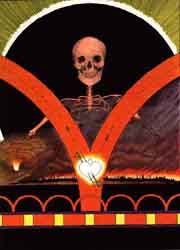
4 Martinus has symbolized (symbol 19) that state which he calls "through
the initiation of darkness, (Hell or Armageddon)". Here is shown the
culmination of darkness or the killing principle. The triangle over the
heart symbolizes the being's I and the heart figure is the physical organism
of the being, while the two swords in the heart figure symbolize the killing
principle. At this stage of development, the human is reacting with hatred
and revenge, when it is exposed to dark fate. This being is able to react
to all forms of dark fate, represented by the orange arc at the left in
the figure, by giving it back using the same coin. An eye for an eye and
a tooth for a tooth is the ideal here. Thereby is sent out a new wave of
fate or karma represented by the orange arc to the right, that this entity
will receive again in this or latter incarnations. The cold materialistic
apprehension that a person is extinguished at death, is symbolized by the
skull death's head. The town in the background, with its many houses, domes,
towers and factory chimneys, symbolizes the present cultural area of terrestial
humanity. In spite of the positive intentions of science, it has far from
been able to give security and world peace. It has in its unawareness created
weapons, atomic bombs and a variety of killing machines, by which it has
multiplied the killing capacity of the human kind, far more than any full-blooded
beast of prey is able to. 5 This fact, that intelligence is in the service of egoism and of "the
killing principle", creates the basis for that state of consciousness
that Martinus calls "the devils consciousness" [17]. With it,
the human creates the fears of war, fury and the cruelties of concentration
camps, yes, they create the uttermost darkness, which is hell incarnated
on earth. Thus, this is the only real existing hell, and there is neither
a "devil" nor "hell" after death as in the traditional
form of Christianity. 6 On darkness and "hell" Martinus writes: "But we can see,
that by all those that "died" on the battlefield or "died"
by the hand of hatred, as well as all those that "died" for other
reasons, sickness and aging, there is in fact no "death". That
which is perceived to be "death", "hell" or darkness,
was nothing more than a "colouring agent", a "decoration
material", "dark paint", that the immortal I in connection
with God's modelling and painting hand behind their dead bodies was using
in the design of its life´s artwork: "The human being in God's
image". Dead bodies, corpses in their graves are only the shavings
or the residue matter left over from this divine process of creation, this
divine alteration of mentality from "animal" to "human being""
[18].
7 In this way evolution continues: "To transform the human being from the state of an animal, into an ideal human that is so perfect that there is no way in which its manifestations could cause suffering or pain, but always emanates light onto its surroundings. To transform the animal into such a being, it takes millions of years. And since the human being is now aware of this one single life in which it lives, then there is not much overview on this enormous panorama. But they will see. They will be able to learn that they are themselves eternal, that this present life is not the beginning. If it were a beginning, then there would not be any justice in this world. Then everything would be devastating" [19]. |
Symbol 19 Through the Initiation of Darkness (Hell or Armageddon) © Martinus Ideal Fund 1964 See a closer analysis of the symbol in "The Eternal World Picture II" by Martinus under symbol 19. |
8 We are now in the transformation from animal to the true humankind, and
in this process we will pass through both good and bad experiences, both
happiness and pain. Martinus describes the evil as the "unpleasant
good" while he describes the good as the "pleasant good".
Both of these have their proper authorization in the process of humanizing
mankind. Locally, the "unpleasant good" will of course be experienced
as evil and one will often find themselves in difficult situations, where
they feel that no matter what they will do, it cannot be avoided that harm
for others is created. In such situations Martinus advises us to do the
least harmful. 9 It must be emphasized however, that there is a way out of darkness. Gradually, as each person gets on with their development, until they consciously can start working on their own evolution and humanization process, they cannot according to Martinus avoid noting how things will change. Consciously they can start working on their own humanization process by getting rid of all negative tendencies in their minds and daily ponder upon what good they can do to their neighbours. Even if there still will occur much evil in this world, they can start searching their own minds to find out, what will give an unhappy fate and what will create a good fate. Finally, it is only themselves, through an inner struggle, that are able to start loving their fellow beings and thus get out of the sphere of sufferings. Through this journey they will get a growing insight and knowledge about themselves and their fellow beings, far and near. |
Symbol 23 The finished human being in God's image after His likeness © Martinus Ideal Fund 1964 See a closer analysis of the symbol under "Reincarnation, karma and development" or in "The Eternal World Picture II" by Martinus under symbol 23. |
Microcosmos, mesocosmos and macrocosmos.

Reincarnation, spiral cycles and destiny.